

Related Posts



Conversation Starter
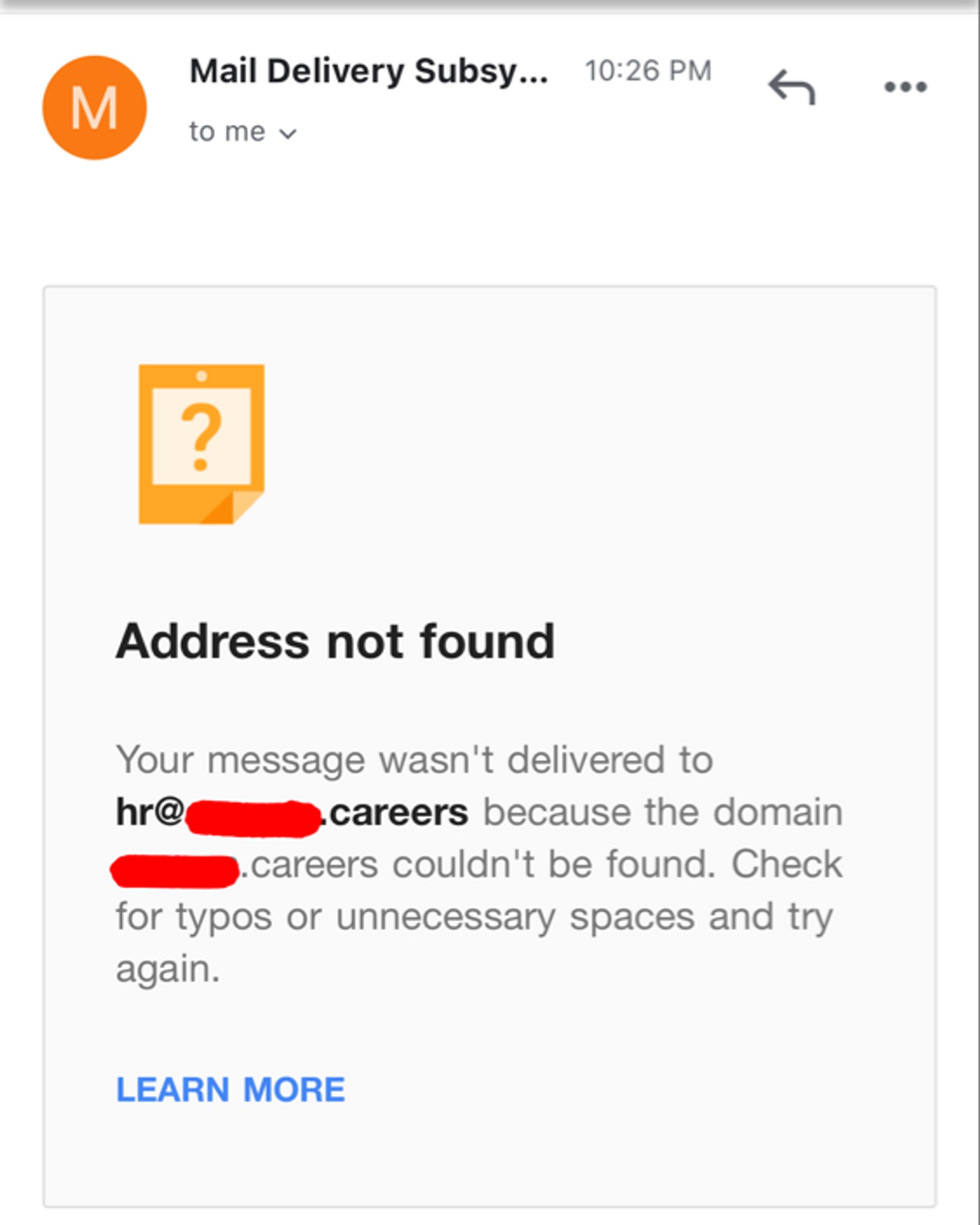
The new company I’m at now sent me an email from an email address that was HR@companyName.careers saying I was accepted for the position. They gave me paperwork to fill out and sign to accept the position
I fill out the paperwork and send it back to them and it goes through… then a few days later I go back to the email to say something else and I get this…?
Then today I got a check from the company In the mail to setup my home office, and it’s signed by someone I’ve never met before or heard of…?
What…..

More Posts


Additional Posts in Veteran Bowl

Community Builder
Conversation Starter
How much do you put into TSP?
McKinsey & Company Anyone at McKinsey & Company willing to refer a Marine veteran (OIF, I swear I will not eat all the crayons. "Crayons" are for art is what my wife tells me to tell myself)
5yrs Marines (Sgt, Comm maint tech w infantry Bn)
8yrs in Oil & Gas (engr coordinator, qty surveying and proj ctrl)
CM undergrad
MBA (professional program, graduated May 2022)
I'm looking for a role in McK serving O&G, industrial, capital projects clients. Open to generalist roles as well. Can review for vetting.


Pro
New to Fishbowl?
unlock all discussions on Fishbowl.


This is the big lie. "If I word my resume right, then I'll get the interview."
Translate military terms into business jargon, sure. But you can't fit a square peg in a round hole.
I'd be focused on gaining relevant business skills. Once you do that, THEN that leadership and managerial experience will mean a little more.
Unfortunately, this may just be right because military members think with that just because they have service they think that they’re going to walk in the door and get hired right away when they have no clue about the civilian world.
I worked with hiring our heroes at an event we had a group, really small group, come in from one of the Air Force bases. their colonel, Not a full bird, said he had an interview the next week he wanted us to mock interview in. We did that, and on a scale of 1 to 5, being the best we would’ve scored him a two.
You also have to be aware of how the company that you’re interviewing with interviews people. You have to do your homework on the company that you’re interviewing for. These are just a few other things not all of them but again to Booz Allen Hamilton 1’s point it is the big lie.
As an actual executive in the business world who was both prior enlisted and commissioned, I’d be more willing to give you advice/expectation setting. But the way you are speaking to others in this thread, frankly you don’t deserve help. Your replies to genuine advice are toxic, and I would not hire you as a supervisor if that is how you engage a team. Leave the ego behind, it won’t serve you well in the civilian world.
You must make more than me so please let me know how to get that F500 executive role.
*awaiting snarky reply from OP*
was u sittin in cockpit or ?
OP’s replies to comments here…yikes. Hope you’re just extremely stressed ATM.
@Deloitte 3: No one said you automatically qualify for a leadership position, don’t try to flex your Deloitte entitlement on me. Just because you didn’t get to deploy, or lead soldiers through thick and thin in OH SHIT scenarios OR completely missed the purpose of either - doesn’t mean other NCOs spend their career yelling at someone “to get a haircut and stay off the grass.” Don’t stereotype military because you experienced shitty leadership or didn’t get duty stations you wanted. Veterans have plethora of skills they can bring to an organization. They also can transition to be excellent civilian leaders, and many of them own successful businesses past their military career. This is not a one size fits all scenario. Stop hating on our veterans and give them the opportunity they deserve!
You’re likely not qualified, clearly not ready, and absolutely not helping the case for companies to treat NCOs and Os the same in recruiting/screening
Agreed with the hands-on expertise, but your dialogue and general perspective indicate you’re socially inept - the downfall of many “highly qualified” NCOs. Like the military, once you get more senior in any organization you get further and further away from turning wrenches and your social skills become much more impactful.
Mainly this post reads as someone that only knows how to turn a wrench and hopes 10,000 hours of wrench turning has earned you a higher wage than a wrench turner when you lack the required skill set.
I want to help you but the way you’re replying makes me lean the other way. But for the sake of helping OTHERS I will lean in.
Focus on impact, outcome, and metrics when possible. Nobody cares how much SI you were accountable for, that’s not P&L. Infantry is a tough one because there really isn’t a lot of 1:1.
Example.. Ok so you were a 240 gunner and were the platoon “SME”.
“Created and delivered a platform training curriculum for ~35 individuals with varying degrees of familiarity, leading to a 200% increase in certification”
Another example - you were part of mission planning.
“Strategized with direct and senior leadership on optimal route, equipment, and mission outcomes for 10+ missions”
Lastly accountability of your direct reports.
“Directly accountable for the livelihood, and career progression of 6 soldiers” and out of this you can pull a metric of like “76% of direct reports outperformed duties and were awarded specialist schools, which was above the company standard”
It’s the same formula for real world experience as well. Get to the root of what you’re really trying to convey.
“Lead the creation of a reference architecture currently in use at X” - great, but what does this mean? Did you reduce cost somewhere? was this reduced elsewhere? Did they build a new application driving revenue on the platform?
Same with sales. “Exceeded quota by 55% YoY” - that’s great, but did that help you expand to a new market, disposition a competitor? Etc.
You see what I’m getting at here
This is going to vary based on what you did in the military. Use the STAR format and then send the draft to as many people OUTSIDE the military as possible for feedback. LinkedIn has been massively helpful in that regard. Finding hiring managers, especially those that are veterans, is very easy and most will be more than willing to help out.
Also, if you are ok with paying for it, look up Adam Karpiak. He offers a resume review for ~$250 and has helped many veterans in this department with verifiable results.
If you need some guidance in translating your combat arms skills into the business world, hit me up, and I can set up a chat with you. I coach the fellows at The Honor Foundation (SOF military-to-civilan transition org), and it is indeed a process, and a chat forum is not going to help you.
That being said, I know it is hard to hear this but, realistically, breaking into an executive position in a Fortune 500 company with no market and/or P&L experience is like having a Harvard graduate and college athlete go from that to becoming your Infantry battalion commander without any military experience in between.
That's odd as your original post stated this was for YOUR E-8 experience. Now, it is for someone else?
Once we know the position, it will be easier to provide bullets so it can tailored to the role and industry. One question would be if you are an internal or external candidate? Another question is if you were approached about this position or just applying & hoping to get an interview?
Additionally, I would suggest following Micheal Quinn on LinkedIn (retired E-9) if you don’t already.
Aside from that, COO is about leading strategic vision for a company, including financial direction. It’s less about leading people and more about ensuring the entire enterprise survives and thrives.
Perfect, translatable bullet points on a resume may get you an interview but I can guarantee any employer worth their salt will see right through OP and that attitude.
The advice given so far is probably not what OP wanted to hear but it’s 100% on point. Also, only one I see in this post trying to “poo-poo” and show off in this post is OP.
I wanted to add to my last post on this subject that there have been former soldiers (NCOs and officers alike) who have broken into the executive ranks of top business/finance companies, but they usually have a top school MBA and/or a Series 7 license (or commensurate preparation) to make up for their lack of market experience. They are usually hired on the basis of their tremendous potential, enthusiasm, and perceived ability to adapt (and, thus, be "molded" into a specific corporate culture). For this to occur, there needs to be a synergy of action between 1) the applicant doing everything possible to stand out of the crowd of in-market experienced applicants, and 2) a corporate recruiting team that is sensitive to how a highly prepared and motivated veteran may bring value. Without either of these, you're dead in the water.
OP is a winner haha 😂.
This guy has to be bored on staff duty.
First off….nobody’s gonna GAF about how many hundreds of people you “lead” or haw many hundreds of millions you were signed/responsible for. One of either two things are why.
The numbers are astronomical and are too big to realistically grasp.
They aren’t relevant to what you need to bring to the table.
You are not wrong.
I'm a fan of reverse engineering these.. look at the job description and figure out what you did that relates to the responsibilities and requirements. Far too often military resumes include content that is irrelevant to the role they're applying for, this is an easy way to keep it concise and relevant.
I help vets do this in some of the foundational coaching I do and it varies by your MOS.
I'm a 2311 and my initial bullets will be different from anyone outside hazmat warehousing and distribution but ton overlap with standard supply and ground freight (Motor T, Embarker). Not that I've been out for quite some time, it's been a lot easier to speak about what I've done by at first it requires a lot of work to understand terms, etc.
DM me your MOS or a way to get your current resume, and I'll send some thoughts back.
What job are you applying for?
I would love to know as well!
Highlight aspects of what you’ve done. Let’s say your team implemented a new procedure which added to the efficiency of your unit or you created a training program to reduce training time and get team members up to speed faster.
So you might say “led a team of 10 to implement xyz training program, which boosted recruitment and new employee onboarding, maximizing training time and saving X dollars a year”.
Generally I use the highest position and only list things that are directly relevant to the job.
And as others have said, it’s far more effective to use the job description - here’s how:
1. Strip the narrative job description into list form, sentence by sentence.
2. Strip each sentence into key word or main thing.
3. Organize by theme as best you can (hard / soft skills or whatever make sense)
4. Eliminate redundancy (they often repeat a lot)
5. Describe a time you did each of their requirements from your experience.
6. List that as a bullet under your most senior role (E8)
Note: Avoid saying things like “responsible for X amount of gear worth Y amount of millions of dollars”.