


Related Posts

Hi all,
Need help , can anyone let me know if Accenture is giving work from home as of now ? I mean i have been offered, and the HR is telling me to collect the assets from the base location and the policy of dispatching the assets to home location is no more. Now initially it was communicated it will be work from home for at-least 6 months now i am building trust issues to join the organisation.
Accenture India Accenture Accenture


Rising Star
More Posts


Bowl Leader
Hi Folks, There are multiple openings at Meesho Please refer the Careers page and let me know if anyone needs a referral.
SDE 2/3/4
Sr. / Data Analyst
Product Analyst
Sr. /Business Analyst
Sr. / Engineering Manager
AM/Manager/Sr. Manager - Strategy and Operations
Sr./ Program Manager
Sr/ Product Manager
Chief of Staff
Head of LaaP
Devops and many more. Reach out to me on LinkedIn. https://www.linkedin.com/in/naman-singhal-b92a7a152
More information in comments.
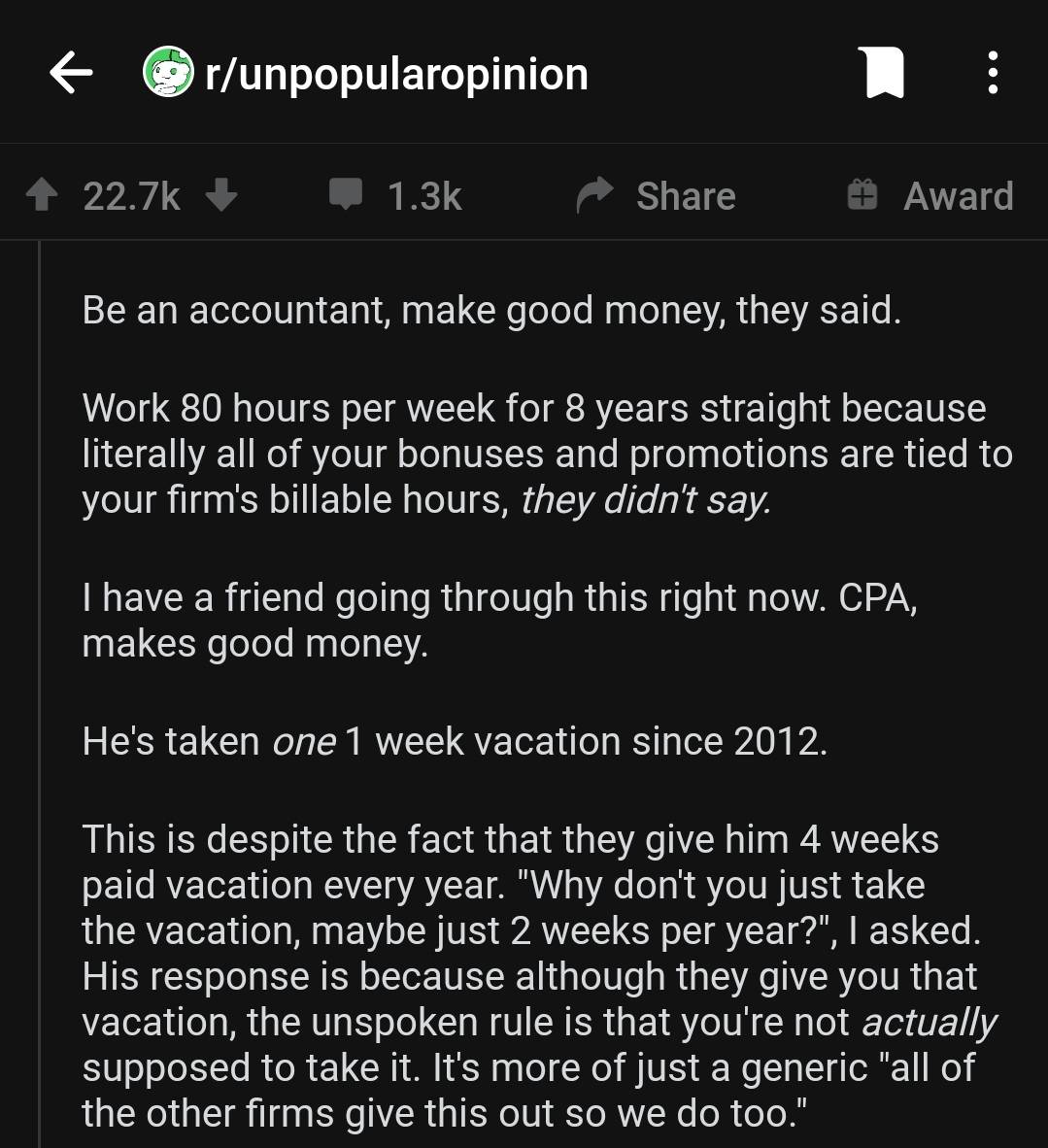
Not my text. But for real.


Additional Posts in Accounting
Which one of you wrote this? The feels...

Top worst audit industries?
Starting salary for a tax accountant in MI?

Pro
All right people. LET'S FILE SOME TAX RETURNS.
New to Fishbowl?
unlock all discussions on Fishbowl.


I find i work more efficiently at home and more hours at home vs the office
KPMG 2, you continue to misunderstand what is being written.
EY2 merely observed that THEY PERSONALLY (not EVERYONE, not MOST PEOPLE IN SOME HR SURVEY bit theg themselves individually) work more efficiently/productively at home than in the office.
Google what the word efficiently or productively means.
You keep insisting that in your personal experience those who report to you do better quality work when you see them at the office than others who work for you but do so from home.
I bet you believe your high performers only are high performers because they are in the office. While u simultaneously believe your poor performers would perform better if they came to the office. Talk about confirmation bias.
Don't compare different people. Compare ONE person to themself. I.e., does the individual you are evaluating do better work when they are at the office or when they are at home or is there no difference in quality regardless of where that individual works?
Personally, in the EY Manhattan office, I cannot get half as much work done as the amount of work I can get done at home. Too much noise, too many people (probably people like you, having loud phone calls or impromptu meetings at your cube) distracting everyone else around you. I have been in public acccounting for over 25 years and the new office models that are built like a Google office simply don't work for 75% or more of accountants at Big4. We need QUIET to concentrate on numbers. We aren't collaborating on out of the box strategies. We are crunching the numbers and counting the beans and writing technical accounting/tax memos. Work from home is the ideal and the only ones who dispute this are the control freaks and those with tiny studio apartments that they share with roommates.
Now get back to micromanaging your teams. (I know your type)
yes, it’s fair. wfh is a benefit.
Well no driving - no gas cost for wfh think of that.
They pay less = I will start working less
You think that but I’m lead senior on all my jobs..
They have more expenses related to commuting and having to live a commutable distance to the office, which are usually in cities which are higher col
If they live out of the expensive city, their col is already lower.
So if someone has a 1.5 hour commute vs someone with .5 hour commute, they should be paid more? The math ain't mathin'.
I’d take a pay cut to not have to deal with the middle management personality type that knocks on your desk because you’re wearing noise cancelling headphones for them specifically to not be heard.
Less people are willing to work in office, therefore firms pay more. There are a lot more people willing to work remote, so firms don’t need to pay as much. It’s more supply/demand than anything.
No, it's bs. I wfh and watch people in the office spend more time "filling their water bottle" than actually doing anything. Then when they do work, it's wrong and I get to fix it, despite them getting more training than those of us at home. They tell people they need to go back to the office, so they do it, for a day, then go back home. They're there just barely long enough to be classified as "in office." There's zero oversight or accountability in office anyway, so what's the difference?
Yes. They spend at least $4k less in commuting costs a year in my office.
This is why in person attendance was the driving factor in our assessments this year in my group. Everyone has a similar level of performance so it’s not equitable that the people who don’t show up are paid the same as the people who do.
People who regularly commute would have additional fuel and car maintenance costs that the WFH person doesn’t have.
I beg to differ. Why would you assume that people in office are not working as much/working as hard? I constantly hear talk about how great WFH is since you can run errands, spend time with kids, do laundry and cleaning, etc.
I get so much more of my job duties done at home that much quicker because I don't have to waste my time going into the office every day. So yes it does free up time to get some other things done. The people who want you back in the office seem to be those who do not know how to organize their time on their own.
I'm confused by this whole conversation. Since when does an employer give a rat's behind about an employee's housing costs, commuting costs, time spent sitting in traffic, etc. They want the work done. Whether someone is WFH or in office, employees should be paid the same for the same work. If anything, the WFH people are saving the company massive costs in leased space, furniture & fixtures, supplies, etc. allowing many offices to downsize their leased space and utilize shared desks/workspaces for hybrid employees and the WFH folks who visit the office periodically. My last employer changed the whole staff from in-office to hybrid (or what I call "mostly remoters") where we would show up once or twice a month for lunch-and-learns, team building, etc. All except his office, the conference room and 3 cubicles were turned over to another department that needed the space. We had a reservation system for the cubicles/conference room on a Teams calendar. Should the mostly remoters get a drop in pay? No! We were doing as much or more remotely than we could get done in office and saving the company facilities costs. JMO
Yes.
Yes - you say you're doing the same work, but you also aren't as easily available to take on quick, small projects or tasks because someone has to be at their computer to communicate with you - it they are walking by your desk, they can ask if you have some time available and give you that opportunity. You also miss out on casual work related conversations that may impact your tasks or you may be able to provide important/useful input to because you aren't there and can't hear it.
I completely understand this and will go to the office as a team. I don’t see the point in going in if the team isn’t going to be together.
Yep
I know EY promoted slower for those that WFH than those im office. This was before the pandemic. They're doing the same exact work. It was so dumb.
Absolutely, no wear and tear on vehicle, no gas out of pocket for vehicles, no travel time to and from......
When you work from office, you get asked a bunch of questions from younger folks. You have to spend time taking them out to lunch, build culture. So yeah you do more when you’re in office.
Client work on the other hand can be argued both ways. Peace and solace at home has its perks. Asking PPMD a question in person is more efficient than scheduling calls to discuss. Etc etc
WFH isn't getting paid less, RTO is getting paid more. For me to convince you to RTO every day you are going to want more money now. Supply and demand.
Yes
I love how it’s the people who are forced to RTO that are the ones who are so adamant about others that get the opportunity to WFH being paid less. Ever heard of the crabs in a bucket? One tries to escape and the others team up to pull them back in the bucket.
Why do you think people in India get paid less?
From my experience with the GDC team, with proper instruction, I find them to be more efficient, as they handle multiple engagements at the same time even at level of senior / associate.
Regarding compensation, what may seem like lower pay in the U.S. actually appears higher when converted to INR (, this difference is primarily due to currency conversion) and another perspective is purchasing power parity. I hope this provides clarity.