

Related Posts


Bowl Leader

More Posts

Additional Posts in Attorneys of Color


Hi I run a podcast called The Lawtrepreneur Briefing that explores what's makes a modern lawyer modern. We do this by having conversations with people driving the transformation of the legal profession.
Excerpt of the most recent conversation can be found here: https://twitter.com/lawtrepreneurco/status/1282688181419347968?s=19
If any of you have thoughts about the subject, I'd love to have you on. You can apply to speak here: https://www.lawtrepreneur.co/podcastguest/


New to Fishbowl?
Download the Fishbowl app to
unlock all discussions on Fishbowl.
unlock all discussions on Fishbowl.


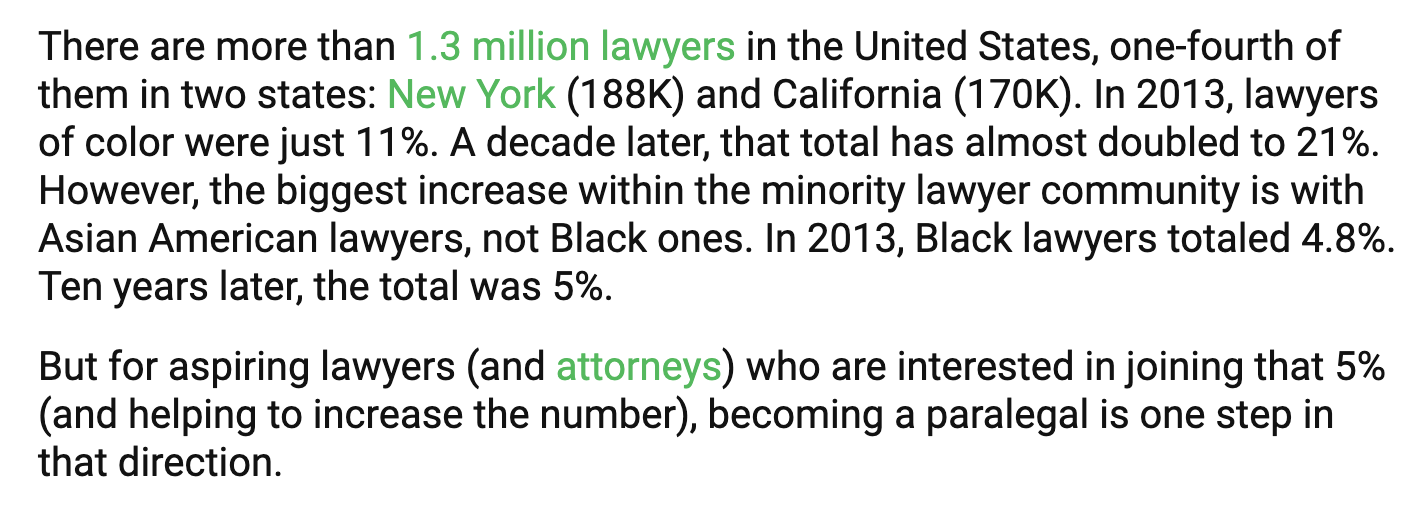
https://afrotech.com/how-to-become-a-paralegal
Under virtually no circumstances is it advisable to become a paralegal rather than an attorney as a purported stepping stone to the latter. And before y’all get in your feelings, I don’t care about your auntie’s cousins baby’s mother who did so: these exceptions do not disprove the rule. Paralegal, not unlike court reporter, is a separate career unto itself, and unless someone is planning at the outset to become a solo practitioner, imagining that you will start off as a paralegal and end up as a lawyer is a circuitous way, if not, derailment to becoming an attorney, altogether. It’s like people saying that community college is preferable to four year when it absolutely is not. While some people get in and out of community college in two years, the vast majority of people find the community college is a succubus and it takes on average six years to get in and out of that system . Thinking one is going to be a paralegal first and then later becoming an attorney is similar.
Of course it’s never too late to go to law school, no matter where you happen to be on the law firm chain (file clerk, legal assistant, paralegal, receptionist, etc.). But wherever you are, it is better to simply bite the bullet and go to the best, most highly ranked law school as possible. Also, STOP, doing what this article doesn’t referring to ourselves as minorities. We are not. We are the global majority and being part of this profession, enhancing language and mindset.
@P1,
I get your point. Careers like teaching, finance, and HR are good alternatives before law school as well, but they can also become long-term like a paralegal.
To combat this, a clear plan is needed. Being a paralegal can be a gateway to law school if you have a clear plan. Without a plan, it can be a deterrent, much like going to community college without a clear direction or alternative careers as mentioned earlier. Many people at my t14 were former paralegals, and they felt the experience gave them an edge. Some even returned to their previous Biglaw firms as associates, and having a plan made the difference. Furthermore, with top law schools becoming more competitive and preferring candidates with professional work experience, being a paralegal prior to law school is good advice if it properly planned.
https://www.usnews.com/education/blogs/law-admissions-lowdown/articles/work-experience-matters-for-law-school-applicants