
You think you’ve got it bad now…



Conversation Starter
Conversation Starter
Conversation Starter
Hi how do we avail gym facilities in bosch
Conversation Starter


Rising Star
Conversation Starter
It’s been real uncle D, but the bag has called
I am not ok.
Good lord this open space is insufferable
The turkeys nest is where you find inspiration
This site is protected by reCAPTCHA and the Google Privacy Policy and Terms of Service apply.
Download the Fishbowl app to unlock all discussions on Fishbowl.
Copy and paste embed code on your site

Scan your QR code to download
Fishbowl app on your mobile





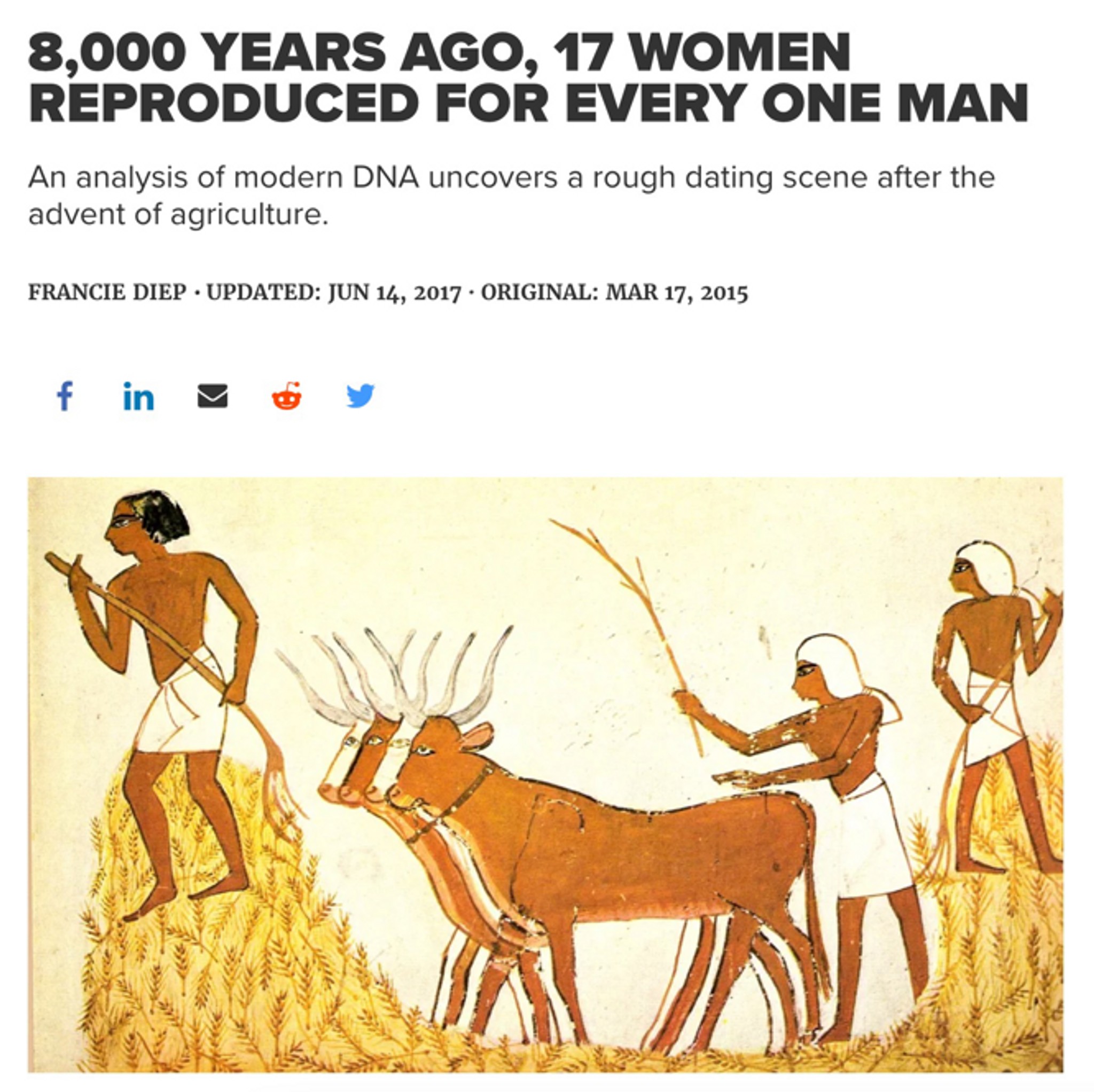
“Once upon a time, 4,000 to 8,000 years after humanity invented agriculture, something very strange happened to human reproduction. Across the globe, for every 17 women who were reproducing, passing on genes that are still around today—only one man did the same.
"It wasn't like there was a mass death of males. They were there, so what were they doing?" asks Melissa Wilson Sayres, a computational biologist at Arizona State University, and a member of a group of scientists who uncovered this moment in prehistory by analyzing modern genes.
“Another member of the research team, a biological anthropologist, hypothesizes that somehow, only a few men accumulated lots of wealth and power, leaving nothing for others. These men could then pass their wealth on to their sons, perpetuating this pattern of elitist reproductive success. Then, as more thousands of years passed, the numbers of men reproducing, compared to women, rose again. "Maybe more and more people started being successful," Wilson Sayres says. In more recent history, as a global average, about four or five women reproduced for every one man.”
... K?
Why share this on International Women’s Day did you get a divorce recently